Agentic AI is a big step forward from traditional “question-and-answer” artificial intelligence. Instead of just predicting the next word or choosing from fixed options, Agentic AI systems can perceive what’s happening, think through options, and then act to change their environment.
They behave less like calculators and more like digital decision-makers that can observe, reason, and take action in loops—very similar to how humans operate.
Below is a simple, beginner-friendly explanation of how agentic AI works, using the pattern you liked earlier.
1. What Is Agentic AI? A New Way to Look at AI
Agentic AI refers to AI systems that don’t just answer questions, but pursue goals. They can handle instructions like:
- “Watch my inbox and draft replies to important emails.”
- “Monitor failed payments and try to recover those customers.”
- “Summarize today’s meetings and create action items.”
Instead of being passive tools, these systems act as agents: they observe data, make decisions, and perform actions—often over multiple steps and over time.
Traditional AI = “You ask, it answers.”
Agentic AI = “You give a goal, it figures out what to do next.”
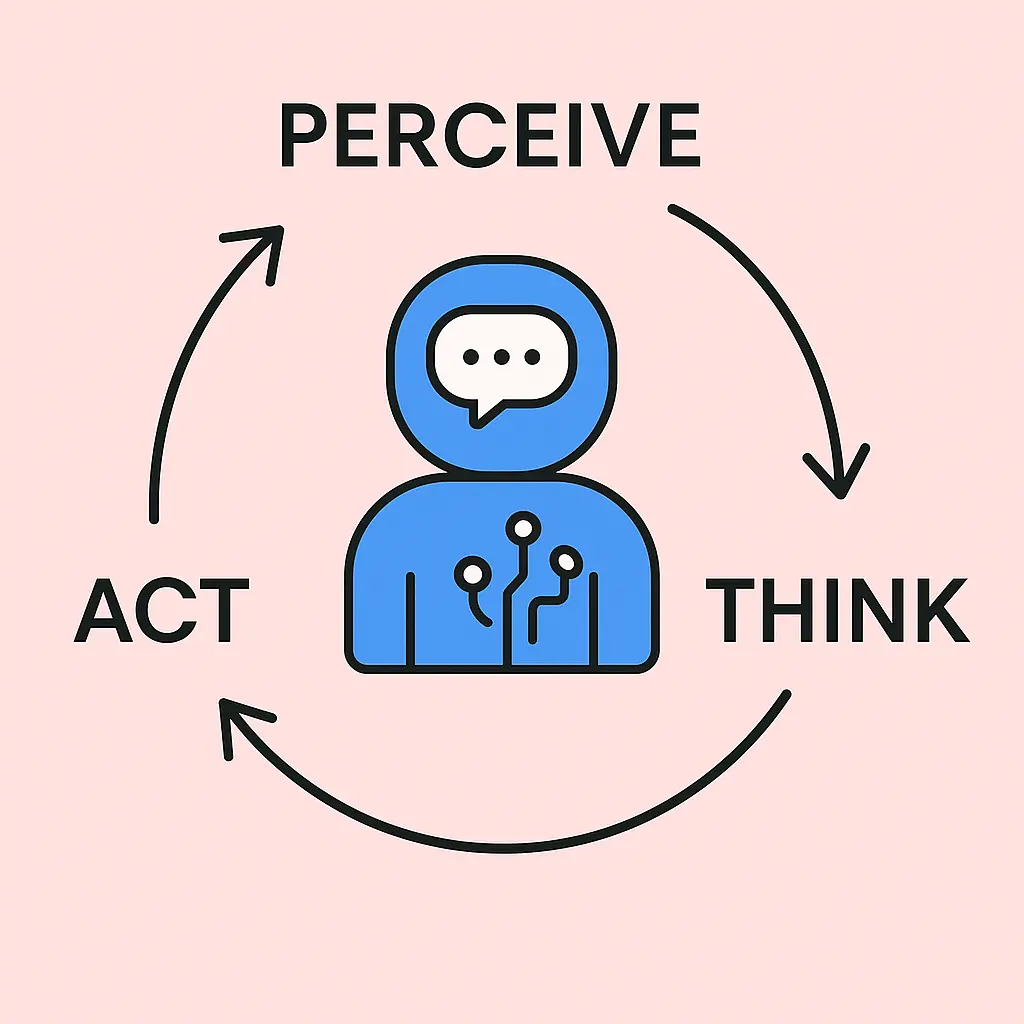
Technical Insight: Agentic AI wraps a model (like a large language model) inside an agent loop. The loop repeatedly takes in observations (state), asks the model what to do next (action), executes that action through tools or APIs, and updates the state. This perceive–decide–act cycle is what gives the system “agency.”
2. Perception: How Agentic AI Sees the World
The first step of any agent is perception—taking in information about the world. For AI, “world” usually means:
- Emails, chats, and documents
- Database records, CRM entries, logs
- Web pages, APIs, sensor data
- User messages or instructions
Agentic AI turns all of this into structured “observations” the model can work with. For example:
- Reading your inbox and extracting sender, topic, urgency
- Fetching rows from a spreadsheet and recognizing patterns
- Scraping a web page and turning it into clean text
Good perception means the agent has a clear picture of what’s going on before it decides what to do.
Technical Insight: Perception often uses a mix of parsing, retrieval, and embedding-based search (RAG). Text, images, or structured data are converted into machine-friendly representations (vectors), which the agent queries to build a context window for the model. This context becomes the “eyes and ears” of the agent.
3. Thinking: Planning, Reasoning & Breaking Down Tasks
Once the agent has perceived the situation, it needs to think:
- What is the user’s goal?
- What information is missing?
- Which tools should I use?
- In what order should I do things?
This is the planning and reasoning step. For example:
- For “recover failed payments,” the agent might:
- Fetch all failed transactions from the last 7 days.
- Check which customers have valid contact info.
- Draft a polite recovery message with a payment link.
- Schedule a reminder.
The agent can also re-plan if something doesn’t work—like a tool failing or data being missing.
Technical Insight: Reasoning in agentic AI often follows patterns like chain-of-thought and tool-augmented planning (e.g., ReAct, function calling, or graph-based plans). The model is prompted not just to answer, but to output a plan: a sequence of tool calls and checks that move the agent from the current state toward the goal.
For this relevant workshop we are here BotCampusAi-Workshop
4. Action: Using Tools to Change the Environment
Thinking alone isn’t enough. Agentic AI must be able to act.
Actions can include:
- Sending an email or chat message
- Creating or updating records in a CRM or database
- Calling an external API (payment, shipping, analytics, etc.)
- Scheduling events on a calendar
- Generating and saving documents or reports
For example, an agent managing your inbox might:
- Archive low-priority messages
- Draft answers to medium-priority ones
- Flag or forward critical messages to you
Each action changes the environment, which the agent can then observe again—closing the perception–action loop.
Technical Insight: Most agent frameworks define a set of tools or functions with strict input/output schemas (often JSON). The model doesn’t directly send emails or edit databases; instead, it outputs structured tool calls like { "tool": "send_email", "args": { ... } }, which a secure execution layer runs. This separation improves safety and reliability.
5. The Perceive–Think–Act Loop in Practice
Agentic AI becomes powerful when perception, thinking, and action run in loops instead of one-off steps.
A typical loop might look like:
- Perceive: Check inbox and CRM for new leads.
- Think: Decide which leads are worth contacting today based on rules (location, budget, interest level).
- Act: Draft outreach messages and log them in the CRM.
- Perceive again: See who replied, track opens/clicks.
- Think again: Decide who to follow up with and how.
- Act again: Send follow-ups or propose meeting times.
This continuous cycle lets the agent adapt to new information just like a human would, instead of running a fixed script.
Technical Insight: Looping agents must avoid infinite loops and “runaway” behavior. Many systems use explicit step limits, cost budgets, or termination conditions (e.g., “stop when there are no more leads,” or “stop after 10 tool calls”). Logging each loop iteration is key for debugging and auditing.
6. Real-World Examples of Agentic AI
Here are some real-world patterns where agentic AI shines:
- Email & Calendar Agent: Reads new emails, categorizes them, drafts replies, proposes meeting times, and creates calendar events—often requiring only your final approval.
- Invoice & Finance Agent: Watches a folder for new invoice PDFs, extracts line items, categorizes expenses, updates a spreadsheet or accounting system, and sends weekly summaries.
- Customer Support Agent: Reads incoming tickets, checks order status, suggests solutions from the knowledge base, executes simple actions like refunds or resends (within safe limits), and escalates complex cases with a ready-made summary.
- Marketing Campaign Agent: Researches keywords and competitors, drafts social posts or ad copy, schedules content, and generates performance reports that recommend next steps.
In each case, the agent is not just “answering questions.” It’s running a continuous perceive–think–act workflow tied to real business outcomes.
Technical Insight: These examples typically combine three layers:
(1) an LLM for language understanding and planning,
(2) a workflow or agent framework for tool orchestration, and
(3) existing business systems (CRMs, ticketing tools, billing systems) accessed via secure APIs. This layered architecture allows teams to plug agentic capabilities into their current stack instead of rebuilding everything from scratch.
<h2>7. Limits, Risks & the Role of Humans</h2>
Agentic AI is powerful, but it’s not magic. There are important limits and risks:
- Hallucinations & Misinterpretation:
The model might misunderstand instructions or invent details if not grounded in real data. - Over-automation:
Letting an agent send messages or change records without oversight can create mistakes at scale. - Security & Privacy:
Agents often need access to sensitive systems (email, CRM, payments), so permissions and logging matter.
That’s why the most effective deployments use human-in-the-loop patterns:
- The agent drafts; humans review and approve.
- High-risk actions (payments, contract changes, bulk emails) require manual confirmation.
- Logs and dashboards show exactly what the agent did and why.
Technical Insight: Safety in agentic AI uses multiple layers: permission scopes per tool, policy prompts that define forbidden actions, optional “critic” models that review planned actions, and monitoring pipelines that flag anomalies. Combining these controls with human approval keeps agents helpful but contained.
Conclusion
Agentic AI is about more than smarter chatbots. It’s about AI systems that can perceive what’s happening, think through options, and act to move closer to a goal—over and over again.
By understanding the simple loop of Perceive → Think → Act, you can start to see where agentic AI fits into your work:
- What data can an agent observe for you?
- What decisions can it help you think through?
- What repetitive actions can it safely take on your behalf?
As tools and frameworks continue to improve, the real advantage will belong to people and teams who know how to design and supervise these agents effectively.
Stay tuned to BotCampusAI for more simple, practical explanations and real-world examples of how to use agentic AI in your projects and business.