Agentic AI isn’t just another buzzword.
It’s the shift from “AI that answers” to AI that actually does the work.
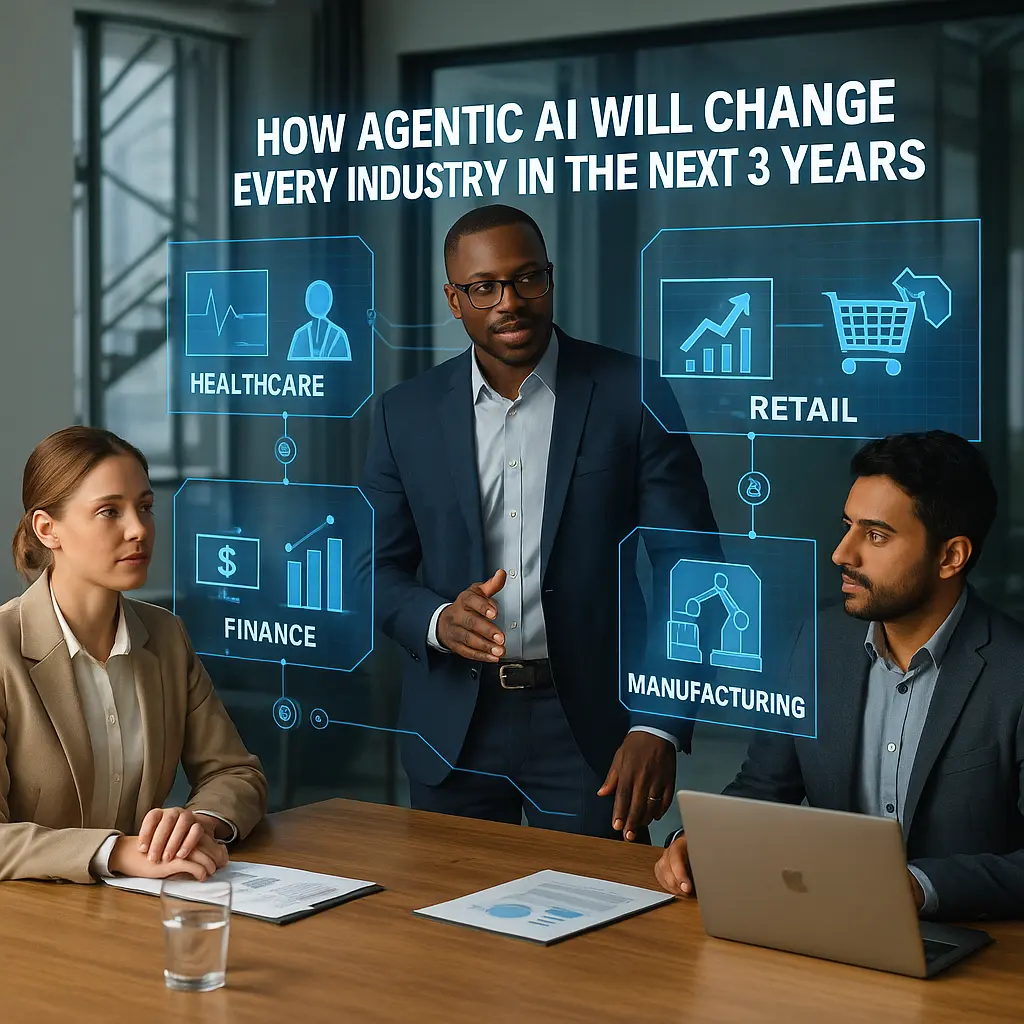
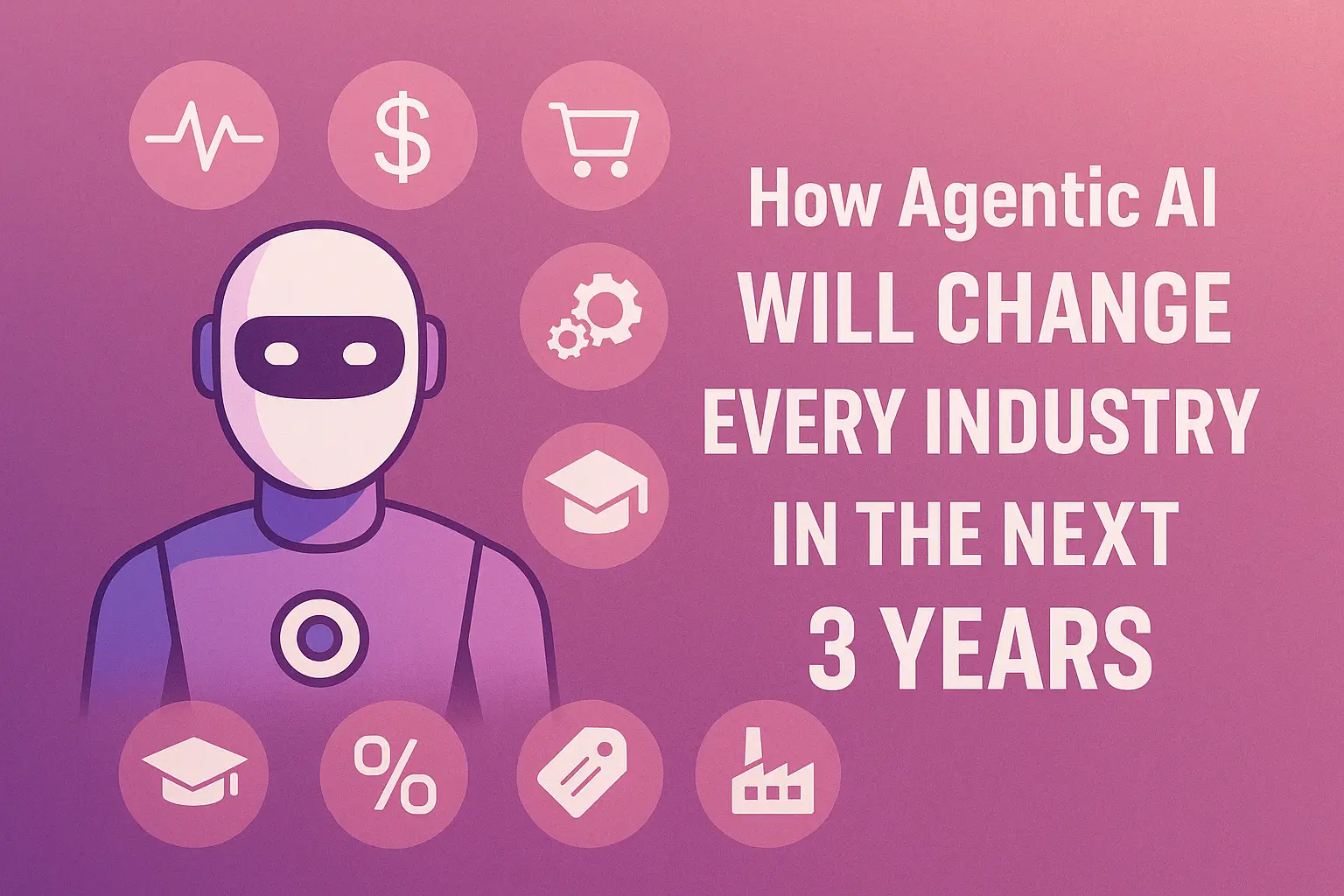
Over the next 3 years, that shift will quietly rewire almost every industry.
Instead of people manually pushing data between tools and systems, we’ll see agents that can perceive what’s happening, think through options, and act across CRMs, ERPs, support tools, codebases, IoT devices, and more.
Here’s a clear, industry-by-industry look at what’s coming—and what it means.
1. The Pattern Behind Everything: Perceive → Think → Act
Every industry, no matter how different it looks on the surface, runs on the same pattern:
- Perceive – See what’s going on
- Think – Decide what should happen
- Act – Do the thing: update, notify, create, ship, schedule
Agentic AI automates this loop.
- In a hospital, that loop might be: patient vitals → risk scoring → early alert
- In retail: inventory levels → demand forecast → reorder or discount
- In support: new ticket → classification → solution or escalation
Once you realize this, you start seeing agent opportunities everywhere.
Technical Insight: Agent frameworks wrap large language models in control loops. The model takes in a “state” (data, events, user input), proposes an action (tool call, query, update), a runtime executes it, then feeds back the new state. This continuous loop turns static AI models into dynamic systems.
2. Healthcare: From Reactive Care to Proactive Agents
Healthcare is full of manual, high-stakes workflows:
- Nurses watching dashboards
- Doctors digging through records
- Admins handling insurance forms
- Patients missing follow-ups
Agentic AI will quietly sit in the background, doing work like:
- Triage agents: scan incoming cases, lab results, and symptom descriptions to highlight urgent cases and suggest probable paths.
- Care coordination agents: ensure referrals, tests, and follow-ups actually happen—chasing missing reports and nudging both staff and patients.
- Administrative agents: read insurance forms, extract key fields, match policies, and pre-fill claims.
Healthcare won’t become “fully automated,” but staff will spend less time chasing paperwork and more time with patients.
Technical Insight: Healthcare agents will rely heavily on retrieval-augmented generation (RAG) over EHR systems and clinical guidelines, with strict access controls and audit logs. Human-in-the-loop review and regulatory-grade logging will be mandatory around any clinical decisions.
To see yourself in Agentic Ai in 3 years Visit BotCampus-WorkShop
3. Finance & Banking: Always-On Risk, Compliance & Service
Finance is already algorithm-heavy, but still loaded with human, repetitive work:
- Analysts reconciling data across systems
- Compliance teams reviewing alerts manually
- Relationship managers triaging client requests
Agentic AI will:
- Monitor transactions continuously, not just for fraud, but for churn risk, upsell moments, and compliance breaches.
- Read documents (KYC forms, contracts, statements), extract entities, and keep systems in sync without manual data entry.
- Act as mini relationship managers, handling routine card issues, limit increases, and installment requests end-to-end.
The key change: bankers and analysts spend more time on judgment and strategy, less on chasing spreadsheets.
Technical Insight: Banking agents combine rule engines (for strict regulatory logic) with LLM-planning. Tools are restricted by scopes—read-only for some accounts, read-write for others—with policy models or rule layers checking each proposed action before execution.
4. Retail, Ecommerce & Logistics: Agents as Invisible Operations Staff
Retail runs on tight margins and endless details:
- Stock levels
- Supplier delays
- Pricing decisions
- Customer experience
Agentic AI will become the always-on ops assistant:
- Inventory agents: watch sales, stock, thresholds, and supplier lead times—raising purchase orders or suggesting transfers before stockouts happen.
- Customer experience agents: handle refunds, exchanges, and shipment issues automatically, pulling data from logistics APIs and updating the customer in one shot.
- Pricing agents: scan competitor prices, promotions, and demand patterns, then suggest or auto-apply price changes within guardrails.
For online brands, this can feel like suddenly having a 24/7 ops team that never gets tired.
Technical Insight: Logistics agents tend to orchestrate multiple APIs—warehouse systems, shipping providers, payment gateways—and maintain local state machines (e.g., “order lifecycle”) so they know exactly when to intervene and what transitions are allowed.
5. Education & Training: Personal “Coach Agents” at Scale
In education, the classic bottleneck is one teacher to many students.
Agentic AI will introduce personal coach agents:
-
For learners:
- Explain concepts in their language and pace
- Track assignments across platforms
- Generate personalized practice problems
- Nudge them when they procrastinate or miss milestones
-
For instructors and training teams:
- Summarize class performance
- Identify students at risk early
- Suggest content updates based on questions and confusion patterns
- Generate quizzes, rubrics, and feedback drafts
Corporate training, EdTech platforms, and universities will all feel this shift: more personalization without multiplying headcount.
Technical Insight: Education agents combine student interaction data, LMS logs, and content libraries. A recommendation layer ranks which “next action” (explain, quiz, revise, escalate to human) has the highest expected learning impact for that specific student.
6. Marketing, Sales & Customer Experience: From Funnels to Autonomous Playbooks
Marketing and sales are already automation-heavy, but still glued together by humans:
- Copy-pasting leads
- Manually segmenting audiences
- Hand-holding prospects across tools
Agentic AI will move teams from static funnels to autonomous playbooks:
- Lead research agents: scrape websites, LinkedIn, and public data to enrich leads, qualify them, and prioritize outreach.
- Campaign agents: propose campaign ideas, generate creatives, run A/B tests, adjust budgets, and summarize results—on a daily or even hourly loop.
- Account agents: watch key accounts for intent signals (email replies, product usage dips, invoice issues) and nudge humans at the right time with context and draft responses.
Instead of manually “running campaigns,” marketers will increasingly design playbooks and guardrails for agents to execute and optimize.
Technical Insight: These agents use feedback loops tied to KPIs (CTR, conversion rate, LTV, churn). Reinforcement-learning-like patterns can be layered on top: try variations, observe performance, increase weight on what works—within budget and brand-safety constraints.
7. Manufacturing, Energy & Field Operations: Agents in the Physical World
Outside of pure software industries, agents will show up closer to the physical edge:
- Predictive maintenance agents: monitor sensor data from machines, detect abnormal patterns, open tickets, schedule technicians, and pre-order parts.
- Production agents: watch throughput, defect rates, and supply constraints and suggest schedule changes or alerts in near real time.
- Energy agents: optimize when to store, buy, or sell energy based on grid prices, weather forecasts, and demand predictions.
Human operators remain in charge, but much of the constant monitoring and low-level decision-making shifts to agents.
Technical Insight: These scenarios combine time-series models, anomaly detection, and LLM-based planning. Agents need local caches of state and sometimes run partly on edge devices to handle unreliable connectivity, syncing summaries back to central systems when possible.
8. New Human Roles: From Doing the Work to Directing the Agents
As agents take over repetitive tasks, the human role doesn’t disappear—it moves up a level.
New types of work will emerge:
- Agent workflow designers – people who know the business deeply and can translate it into agent instructions, tools, and guardrails.
- Agent supervisors / operators – monitoring dashboards, resolving edge cases, and updating policies when things go wrong.
- Data and knowledge curators – feeding agents high-quality docs, FAQs, SOPs, and examples so they perform reliably.
- Ethics, risk, and compliance leads – deciding what agents are allowed to do and where human approval is mandatory.
In other words: less “push this data from Tool A to Tool B,” more “design the system that keeps Tool A and B in sync.”
Technical Insight: Expect a rise in configuration-as-code for agents: YAML/JSON definitions of roles, tools, policies, and triggers. Version control, testing, and staging environments for agents will become as normal as they are for application code today.
9. Risks, Regulation & the Realistic Timeline
Will all of this happen overnight? No.
Over the next 3 years, we’re likely to see:
- Fast adoption in low-risk use cases (summaries, drafts, internal tooling)
- Gradual rollout for higher-risk tasks (money movement, legal, medical) with strict oversight
- Governments and regulators defining clearer guidelines for automated decision-making and data access
- Standards for logging, transparency, and “kill switches” for misbehaving agents
Organizations that win will be the ones that move early but carefully—starting with human-in-the-loop agents, measuring impact, and growing their agent stack intentionally.
Technical Insight: A practical safety pattern is tiered autonomy:
- Tier 0 – read-only, analysis only
- Tier 1 – draft changes, require approval
- Tier 2 – auto-approve safe actions under strict limits
- Tier 3 – full autonomy only where risk is genuinely low
Each tier has its own monitoring and rollback mechanisms.
Conclusion: The Next 3 Years Are About Quiet, Deep Automation
Agentic AI will not arrive as a single “big bang” product.
It’ll show up as:
- A support system that suddenly resolves more tickets end-to-end
- A finance workflow that reconciles itself
- A sales pipeline that feels strangely “self-updating”
- A personal coach that keeps learners on track without constant human reminders
Industry by industry, the pattern is the same:
less manual glue work, more time for high-value decisions and creativity.
The real opportunity isn’t just using these tools—it’s learning how to design, supervise, and collaborate with agents in your own domain.
Stay tuned to BotCampusAI for more practical breakdowns, real workflows, and hands-on guides to building agentic AI into your projects and business.