Artificial intelligence (AI) has transcended its status as a futuristic concept and is now the backbone of a new generation of AI agents—systems that don’t just answer questions, but actually take actions on your behalf. In 2025, builders have more options than ever for creating these agents, from official SDKs and frameworks to no-code studios.
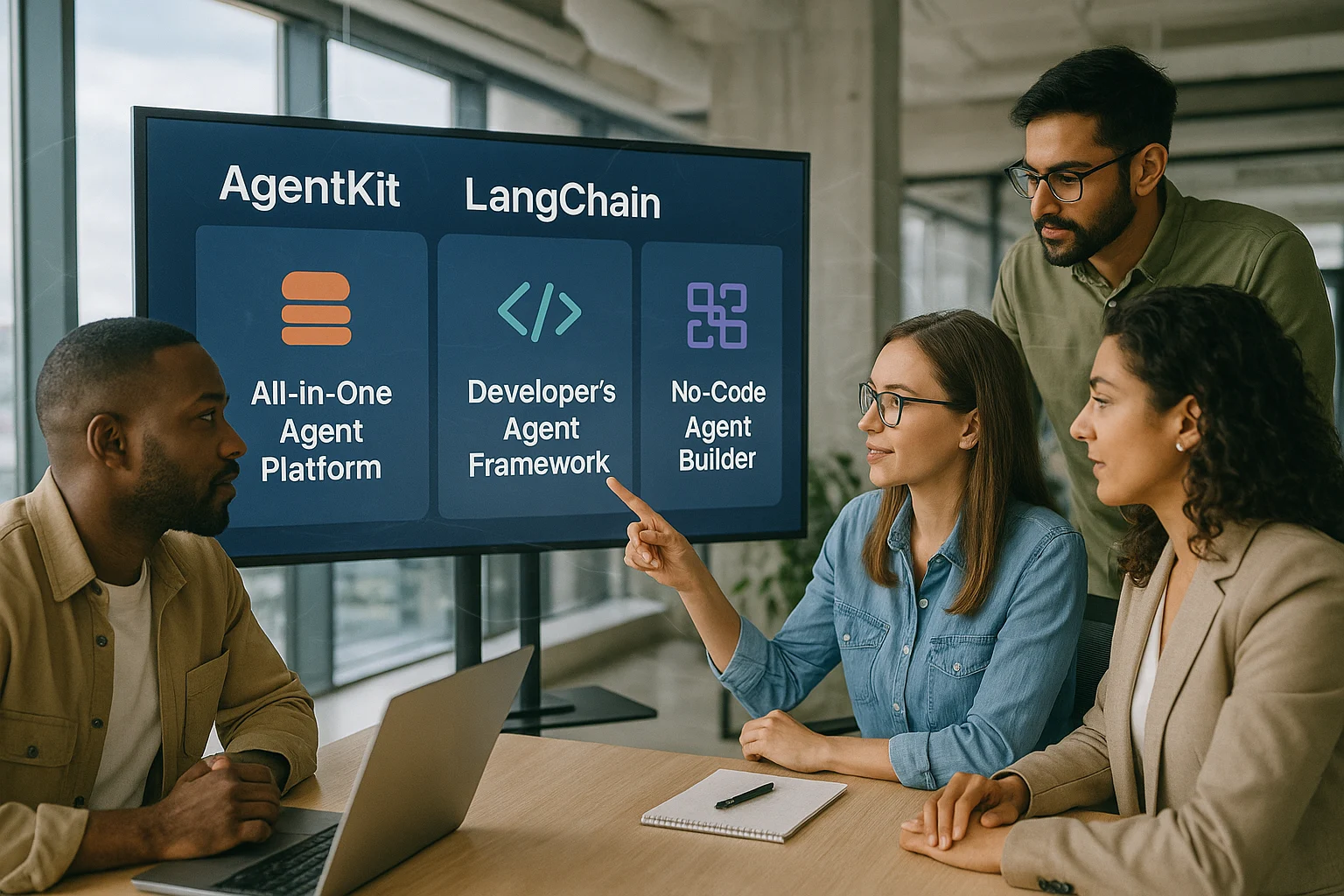
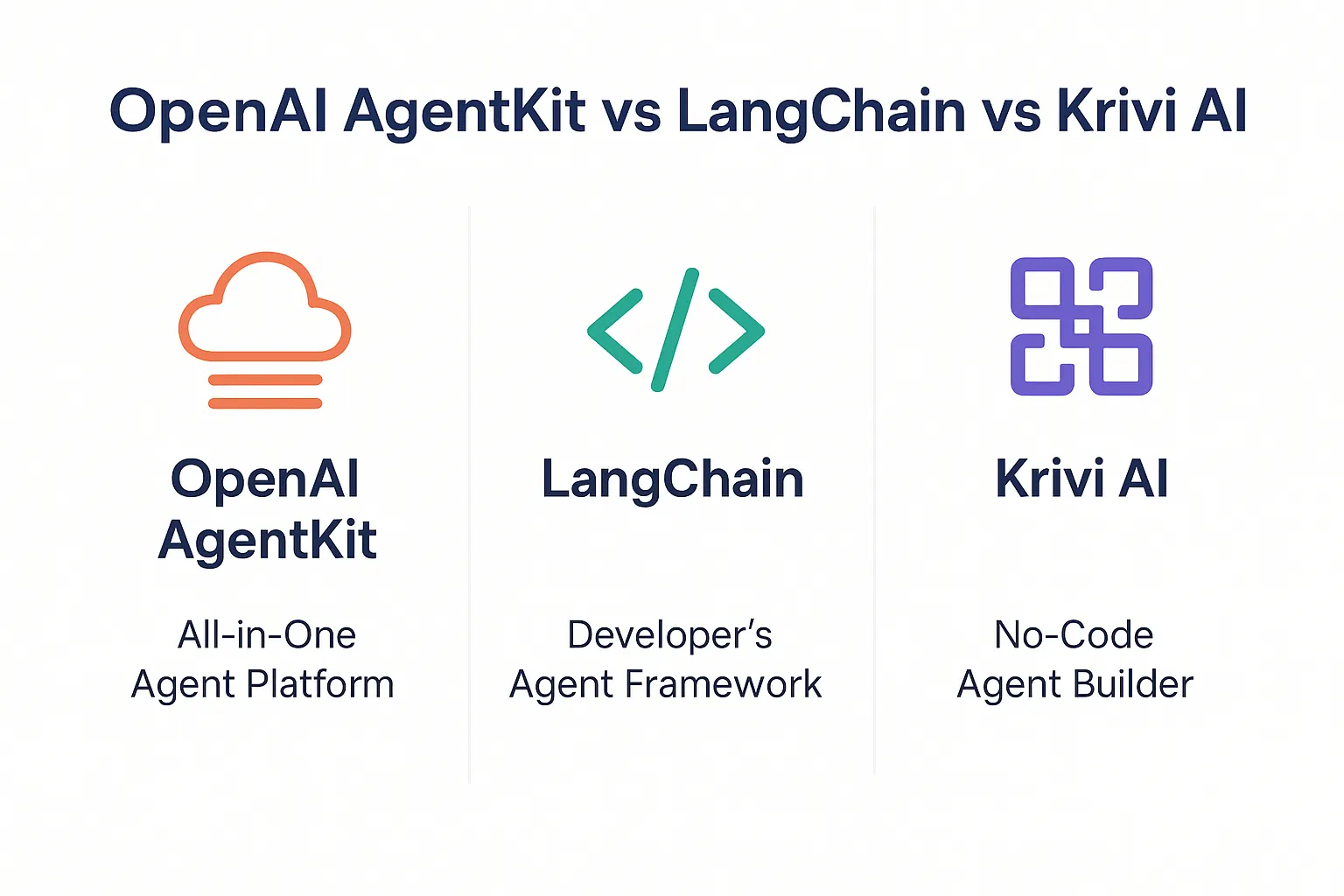
If you’re planning to ship AI agents, three names will come up again and again: OpenAI AgentKit, LangChain, and Krivi AI. Each takes a very different approach to how agents are built, deployed, and maintained.
Here’s a clear breakdown of how they work, where they shine, and how to choose the right one for you.
1. OpenAI AgentKit: The All-in-One Agent Platform
OpenAI AgentKit is designed to give you a full stack for building agents that live directly on top of OpenAI’s models and infrastructure. Instead of wiring everything by hand, you get:
- A way to define agents, tools, and workflows
- Built-in support for OpenAI models (GPT, tools, retrieval, etc.)
- UI components and hosted runtime so you can move quickly from idea to production
If you imagine an internal or customer-facing assistant that can talk to your users, call tools, and show results in a polished interface, AgentKit is meant to be your “official path” to build that with minimal friction.
Typical use cases include:
- Website or product copilots
- Support and onboarding agents
- Internal assistants that sit on top of internal data and tools
Technical Insight: AgentKit’s core advantage is tight integration: model, tool-calling, evaluation, and (in many setups) UI components all live in the same ecosystem. That means you spend less time stitching together auth, logging, and evals, and more time defining your agent’s role, tools, and guardrails. The trade-off is that you’re largely aligned with the OpenAI stack—great for speed, but with less infrastructure independence.
2. LangChain: The Developer’s Agent Framework
LangChain is an open-source framework for developers who want maximum flexibility when building LLM-powered applications and agents. Instead of being a hosted platform, it’s a set of libraries you import into your own Python or JavaScript codebase.
With LangChain you get:
- Abstractions for LLMs, chat models, and embeddings (OpenAI + many others)
- Tools for prompt templates, output parsing, and structured results
- Ready-made patterns for RAG (retrieval-augmented generation)
- Chains and agents that you compose into custom workflows
This is the framework you reach for when you need to deeply control how your system behaves, which tools it talks to, and where it runs (your own servers, your cloud, or your preferred provider).
Typical use cases include:
- Custom multi-step research agents
- Complex RAG systems over large internal data
- Multi-agent systems that coordinate via graphs or workflows
- LLM features deeply embedded inside an existing product/backend
Technical Insight: LangChain is all about composability. You build pipelines (“chains”) by connecting components—prompt → model → parser → database, etc. For more dynamic behavior, you add agents that choose tools at runtime. Because everything is code, you can plug LangChain into any infra: Docker, Kubernetes, serverless functions, or a monolithic backend. You’re responsible for deployment, monitoring, and security, but you gain fine-grained control over every layer.
For Streaming all platforms visit BotCampusAi-Workshop
3. Krivi AI: No-Code Agent Builder for Business Users
Krivi AI sits at the other end of the spectrum: a no-code platform for building agents with a visual interface instead of writing code. You design flows using blocks and natural language, and the platform handles the underlying LLM calls, orchestration, and hosting.
With Krivi AI, you typically:
- Define the agent’s role and goals in plain English
- Connect tools like Gmail, Google Sheets, CRMs, Slack, ticketing systems
- Use triggers (new row, new email, webhook, schedule) to start workflows
- Drag-and-drop logic blocks (IF, routes, branches) on a canvas
This makes it ideal for non-developers—operations, marketing, founders, educators—who want real automation without waiting for engineering sprints.
Typical use cases include:
- Lead qualification and follow-up agents
- Inbox triage and auto-reply assistants
- Invoice/expense processing agents
- Internal “ops bots” that move data between tools and notify humans
Technical Insight: Behind the scenes, Krivi AI orchestrates the same core loop as the coding frameworks: perceive (read inputs) → think (LLM reasoning) → act (tool/API calls). The difference is in how you express the logic: instead of code, you use a visual canvas + configuration panels. This accelerates experimentation but means you’re limited to whatever connectors and logic blocks the platform exposes.
4.Skill Level and Team Type: Who Each Option Is For
Even before thinking about features, ask: who will actually build and maintain these agents?
- If you have engineers comfortable with Python/TypeScript and infra, they’ll appreciate the power of LangChain.
- If you have product teams and technical leads but want strong guardrails and integrated tooling, AgentKit offers a more opinionated, managed path.
- If your “builders” are mostly non-coders—ops, marketing, sales, or founders—Krivi AI’s no-code canvas will feel far more approachable.
Put simply:
- AgentKit → technical teams who like configuration + managed services
- LangChain → developers who want to own the full stack
- Krivi AI → non-developers who want to ship automations without code
Technical Insight: Your “agent stack” will only succeed if the people closest to the workflows can actually iterate on it. A powerful but code-heavy framework in a non-technical team can become a bottleneck. Likewise, a no-code platform in a deeply technical product team might feel too limiting. Matching tool to team is often more important than matching tool to feature checklist.
5. Use Cases and Workflows: Where Each Option Shines
All three can build “agents,” but they shine in different shapes of work.
OpenAI AgentKit is strong when you need:
- Customer-facing assistants embedded in apps or websites
- Internal copilots with good UX and built-in tracking
- Single or multi-agent flows where you’re happy to standardize on OpenAI models
LangChain is strongest when you need:
- Heavy customization over retrieval, tools, and business logic
- Complex workflows spanning many systems, with custom orchestration
- Full control of where data lives and how the system scales
Krivi AI is ideal when you need:
- Business automations around email, sheets, CRMs, and support tools
- Fast iteration by non-technical staff
- Dozens of small agents that automate repetitive operational tasks
Technical Insight: Think about latency, complexity, and interaction style. Synchronous, user-facing agents with rich UIs benefit from AgentKit. Back-end data workflows and research pipelines align well with LangChain. Event-driven, SaaS-to-SaaS automations are well suited to Krivi AI’s visual, trigger-based model.
6. Control, Infrastructure, and Lock-In: How Deep You Want to Go
Another big axis of choice is how much control you want over infrastructure and models.
- With OpenAI AgentKit, you get deep integration with OpenAI’s ecosystem and less infra to manage—but you’re naturally tied to that ecosystem.
- With LangChain, you can mix and match providers (OpenAI, Anthropic, local models, vector DBs, etc.) and run everything on your own infra if needed.
- With Krivi AI, you offload most infra to the platform and focus on workflows, but you’re limited to what the platform exposes and how it’s priced.
If you’re in a heavily regulated environment or need strict data residency, LangChain and self-hosting might be non-negotiable. If you’re a lean startup optimizing for speed rather than infra ownership, AgentKit or Krivi AI will get you moving faster.
Technical Insight: This is essentially the classic “build vs buy vs assemble” decision applied to agents. LangChain = build/assemble, AgentKit = buy into a managed agent stack, Krivi AI = buy a no-code layer. None is universally “right”; the best choice is the one that matches your compliance requirements, budget, and appetite for owning infrastructure.
7. A Practical Decision Framework for 2025
Instead of obsessing over features, walk through these questions:
Do we have developers who can maintain a codebase?
Yes → consider LangChain or AgentKit SDK.
No → start with Krivi AI or a similar no-code agent studio.
- Are we okay being tightly coupled to one provider’s ecosystem?
- Yes → AgentKit gives you speed and polish.
- No → LangChain gives you more portability and control.
- Is this a product feature or an internal workflow?
- Product feature / customer-facing assistant → AgentKit or LangChain embedded in your app.
- Internal ops automation (leads, invoices, follow-ups) → Krivi AI can move fastest.
- How complex is the logic?
- Simple, linear workflows → any of the three will work.
- Complex, multi-agent or graph-like flows → LangChain (often with LangGraph) or a mature AgentKit setup.
- Lots of small, similar business automations → Krivi AI scales nicely without adding more code.
Technical Insight: You don’t have to pick only one forever. Many teams prototype flows in a no-code tool like Krivi AI, then re-implement the most critical pieces in LangChain once requirements stabilize. Others build core logic in LangChain but expose user-facing pieces via a managed agent platform. Thinking in terms of “layers” instead of “one true framework” can give you the best of all worlds.
Conclusion
The landscape of agent frameworks and platforms is evolving fast, but the core question remains simple:
- Do you want speed and managed polish (AgentKit)?
- Do you want deep control and open tooling (LangChain)?
- Do you want no-code power for business teams (Krivi AI)?
Regardless of which path you choose, all three are part of the same larger shift: moving from static AI models to living systems of agents that perceive, think, and act across your tools and data.
As you experiment, start small: pick one workflow, build an agent that genuinely saves time, and iterate. Over time, you’ll develop your own “agent stack” that matches how your team thinks and works.
Stay tuned to BotCampusAI for more insights, comparisons, and practical guides on building and deploying AI agents that actually ship and deliver value in the real world.