Artificial intelligence (AI) has evolved from static prediction models into dynamic systems that can plan, act, and adapt. In 2026, this shift is best represented by AI agents—systems that don’t just answer questions but actually get things done for you. From managing emails and calendars to running marketing campaigns and automating business workflows, AI agents are rapidly becoming digital teammates.
1. AI Agents: From Chatbots to Digital Teammates
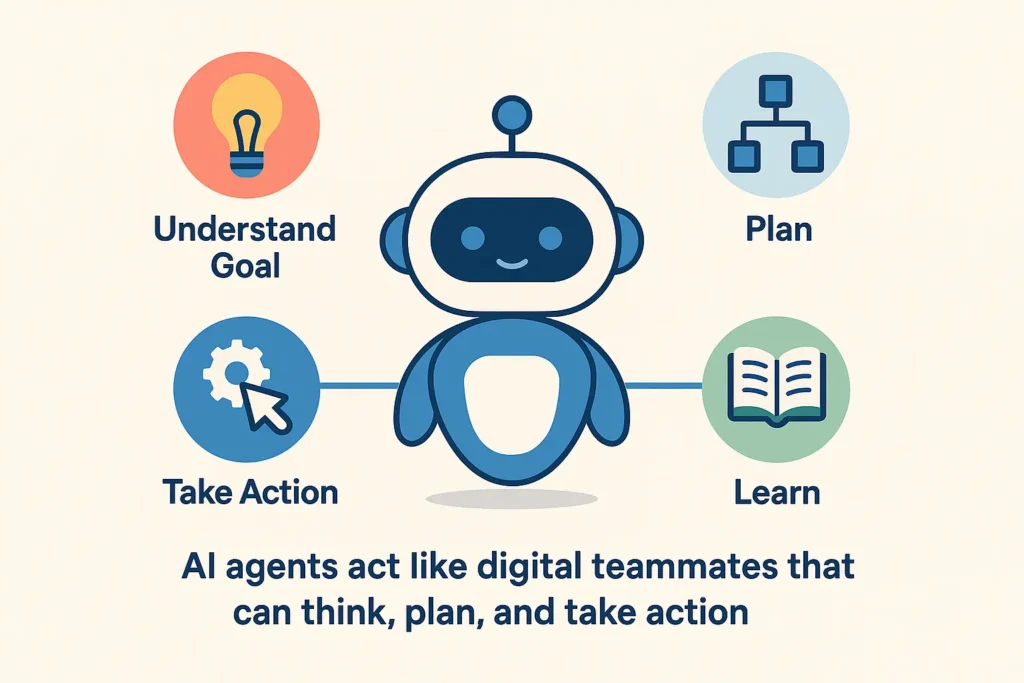
AI agents are a natural evolution of traditional chatbots. While chatbots mainly respond to user queries with text, AI agents can understand goals, plan tasks, use tools, and execute actions in the real world.
Instead of asking a chatbot, “How do I schedule a meeting?” and getting instructions, you tell an AI agent, “Schedule a meeting with Priya tomorrow at 4 PM,” and it will:
- Check your calendar
- Propose available time slots
- Send an invite
- Set reminders
Technical Insight: AI agents typically combine large language models (LLMs) with a “tool-calling” layer. The LLM interprets user intent, while an orchestration layer decides which API or service to call (calendar, email, CRM, etc.). This combination turns pure text-generation models into goal-driven systems capable of real-world actions.
2. Core Components of an AI Agent
Although implementations vary, most AI agents share a set of common building blocks:
- Goal: The objective the agent is trying to achieve
- Brain (LLM): The reasoning engine that interprets instructions and plans steps
- Tools: External services and APIs (email, CRM, browser, database, calendar, etc.)
- Memory: Short-term and long-term storage of context, user preferences, and history
- Environment: The apps, data, and systems the agent can observe and act upon
Understanding these pieces makes it easier to design and debug agents in real scenarios.
Technical Insight: Many modern agents are implemented as “loops” where the LLM receives an observation (state), suggests an action, calls a tool, and then receives updated state. This perceive–think–act loop can be expressed as a planning algorithm (like ReAct, toolformer-style prompts, or graph-based workflows) that keeps the agent aligned to the original goal.
For this relevant workshop we are here BotCampusAi-Workshop
3. AI Agents vs. Traditional Automation
Before agents, automation relied heavily on fixed workflows: if X happens, do Y. Tools like Zapier, n8n, or custom scripts follow rigid rules that must be defined manually.
AI agents introduce flexible, reasoning-driven automation:
- They can handle fuzzy instructions (“follow up with important leads from last week”)
- They adapt to missing or noisy data
- They can decide when to ask for clarification instead of failing silently
This makes them ideal for tasks that are too complex or variable for simple “if-this-then-that” logic, but too repetitive for a human to do every day.
Technical Insight: Traditional automation relies on deterministic logic trees, whereas AI agents use probabilistic reasoning via LLMs. By combining both—rules for safety-critical paths and LLM reasoning for ambiguity—developers can build hybrid systems that are powerful yet predictable.
4. Types of AI Agents Emerging in 2026
AI agents are not one-size-fits-all. Several categories are becoming common:
- Task Agents: Focused on a single job, such as summarizing PDFs, categorizing invoices, or triaging incoming emails.
- Workflow Agents: Chain multiple tasks, like fetching data, cleaning it, analyzing it, and sending a report.
- Multi-Agent Systems: Teams of specialized agents that collaborate—e.g., a Research Agent, an Analysis Agent, and a Writing Agent working together on a market report.
- Personal Assistant Agents: Ongoing companions that manage your inbox, schedule, reminders, and daily priorities.
Each type addresses a different level of complexity and autonomy.
Technical Insight: Multi-agent frameworks often use message passing between agents, where each agent is defined with a role, tools, and memory. Coordination strategies include central controllers, shared blackboards, or decentralized negotiation, and can be implemented using graph-based or conversation-based protocols.
5. Real-World Business Use Cases of AI Agents
In 2025, organizations are deploying AI agents across multiple verticals:
- Customer Support: Tier-1 agents resolve common tickets, check order status, trigger refunds, and escalate complex cases with a prepared summary.
- Sales & Marketing: Lead-generation agents scrape the web, enrich contact data, draft outreach messages, and schedule follow-ups.
- Finance & Operations: Agents read invoices, categorize expenses, update spreadsheets, and generate weekly cash-flow summaries.
- HR & Recruiting: Agents screen resumes, schedule interviews, send updates, and keep candidate pipelines organized.
These agents don’t replace entire teams; instead, they remove the repetitive “busy work” so humans can focus on strategy and relationships.
Technical Insight: Business agents often integrate with CRMs, ticketing tools, and databases via REST APIs or webhooks. A structured output format (JSON with fields like action, tool, parameters) is frequently used to translate natural-language reasoning into precise API calls that downstream systems can trust.
6. Personal AI Agents: Life OS for Individuals
AI agents are not only for enterprises. Individuals are starting to use personal agents as a kind of Life OS:
- Automatically summarizing important emails each morning
- Building a daily to-do list from messages, meeting notes, and documents
- Logging achievements and tasks into a personal journal or knowledge base
- Tracking expenses from SMS/email alerts and organizing them into categories
With small language models and on-device inference, personal agents can run closer to the user, improving privacy and responsiveness.
Technical Insight: Personal agents often pair a lightweight model (for offline or on-device tasks) with a larger cloud model for heavy reasoning. Synchronization across devices uses encrypted storage, while retrieval-augmented generation (RAG) lets the agent pull from a user’s notes, documents, and history without retraining the underlying model.
7. Safety, Governance, and Human-in-the-Loop
As AI agents gain autonomy, control and safety become critical. Poorly configured agents might send the wrong email, delete important data, or act on incomplete information.
Responsible deployment includes:
- Role-based permissions for tools (read-only vs. write access)
- Clear guardrails on what the agent is allowed to do
- Human approval for high-impact actions (payments, bulk messages, contract changes)
- Logging and monitoring of all agent decisions and tool calls
The most effective setups in 2026 are human-in-the-loop systems, where the agent prepares, drafts, and recommends—but a person still approves key decisions.
Technical Insight:
Safety mechanisms can include constrained decoding (to restrict certain outputs), policy models that rate actions for risk, and explicit approval workflows. Some teams also maintain a separate “critic” model that reviews the agent’s planned action sequence before execution, blocking or modifying unsafe steps.
Conclusion
AI agents represent one of the most significant shifts in how we interact with technology. Instead of clicking through interfaces or writing scripts, we increasingly delegate goals and let agents figure out the “how.” From customer support and finance to personal productivity and research, agents are poised to reshape work at every level.
As tools, frameworks, and models continue to mature, the real opportunity lies not just in using AI agents, but in designing smart, safe, and reliable agent workflows that match real-world needs.
Stay tuned to BotCampusAI for more insights and updates on the latest in AI agent technology and practical automation.